"
The Concept Of Schrodinger Equation"
In this blog,you are going to learn the following main topics on Schrodinger equation:
1. Short introduction of quantum mechanics.
2. What is Schrodinger equation?
3. Wave function: an introduction
4. Prerequisites to learn Schrodinger equation.
5. Solution of Schrodinger equation with a simple example.
6. Books to learn quantum mechanics.
So let's begin with the short introduction of quantum mechanics. Quantum mechanics is a branch of physics in which we study about the microscopic and non-classical behaviour of the particles like atoms, molecules and other quantum systems.
The particles like an electron and photons do not generally obey Newton's laws of motion or Coulomb's law of electrostatics. You know that we use Newton's equations of motion to describe the motion of a planet around the sun,in the same approach,we use an equation called Schrodinger equation to describe the motion of quantum particles like an electron moving around the nucleus in an atom.
What is Schrodinger equation?
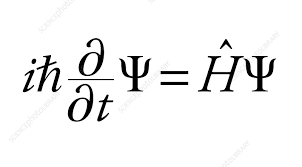
Schrodinger equation is a 2nd order differential equation that involves a complex wave function (psi) as a dependent variable. This equation describes the dynamics of a quantum system. The Schrodinger equation is written in many different ways depending on the context of its uses. Look at these following representations of Schrodinger equation:
A) Time-dependent form
Image source: Google images
Well all these three forms are similar write the Schrodinger equation. Remember that
H= Hamiltonian oparator
E= energy
V= potential energy function
I will not go into the full details of representations of Schrodinger equation. Don't lose hope, I will tell you about it in the last section of this article.
Wave function
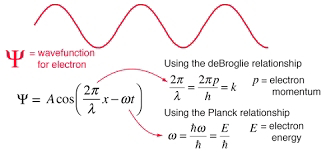
Now it's time to understand the wave function. Wave function is just like any mathematical function ( e.g. f=sinx,f=e^x,...) which is differential and involves complex number.
Here is an example of a wave function
Image source: Google
Remember that psi can take various forms(trigonometric, exponential,...) depending on the system of interest.
In quantum mechanics, wave function is used to represent the state of a system(particle,atom,etc.). Wave function doesn't have any physical significance but according to Born, the square of the modulus of wave function represents probability density of finding a particle.
Prerequisites
If you want to understand the solutions and different ways of expressing Schrodinger equation according to given quantum systems,then you should read these topics from books or internet:
1. Del operators or laplacian operator in Cartesian and spherical coordinates.
2. Solution of differential equations by "separation of variables"
3. Special functions like legendre functions,hermite functions and bessel functions.
4. General Solutions of differential equations using boundary conditions.
5. Solution of Laplace equation in Cartesian, Spherical and cylindrical coordinates.
*You may skip point 3 if you want to solve Schrodinger equation for simple quantum systems like potential well and potential barrier*.
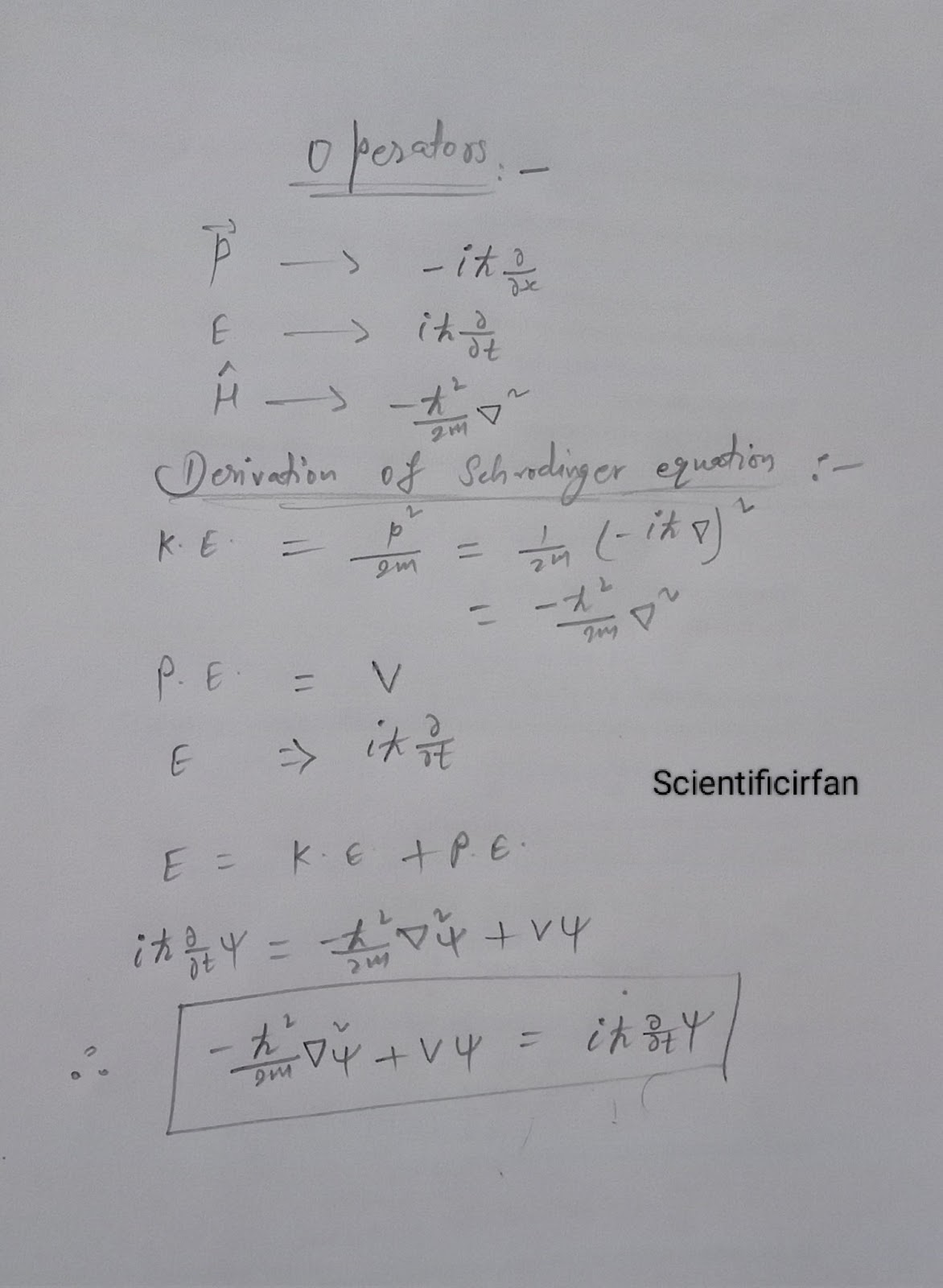
Derivation of Schrodinger equation :
Remember that this is not the actual method of deriving Schrodinger equation and in fact there doesn't exist any method to derive Schrodinger equation from the fundamental principles of physics.
Schrodinger equation is itself an assumption of quantum mechanics which cannot be derived from the basic principles of physics.
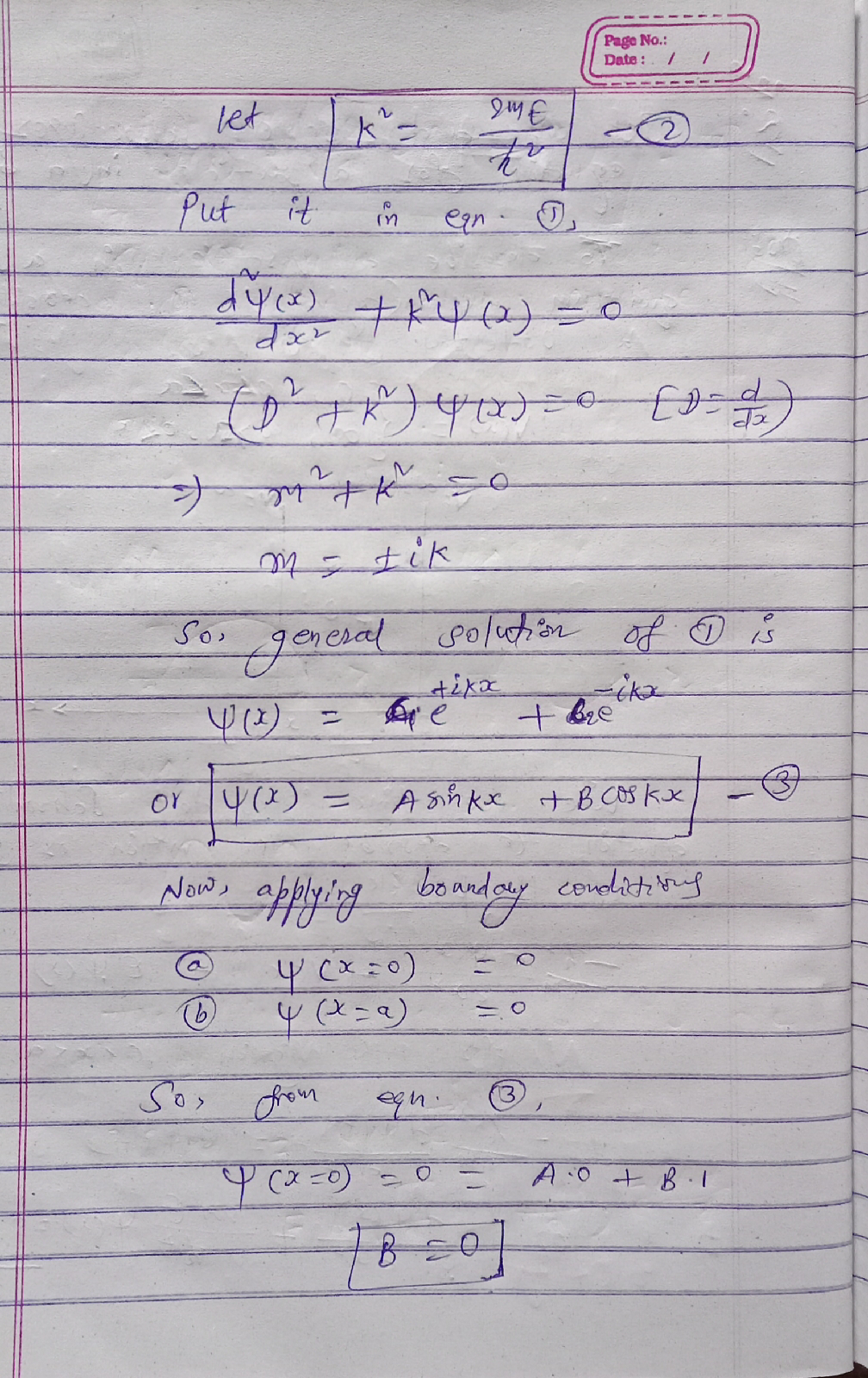
An example for solving Schrodinger equation:
If you are comfortable in solving second order linear differential equation,then this example is the simplest example to understand the solution of Schrodinger equation. Since I can't use mathematical symbols through my phone to write mathematical article,I have to write it in my notebook.
Here is the example:
If you have any query related to this, please let me know in the comments below.
Books to learn quantum mechanics:
I am enlisting some books to understand the Schrodinger equation right from the basics of differential equations to the solutions of Schrodinger equation for different quantum systems like hydrogen atom, quantum tunneling effect,etc.
Keep in mind that you have to be patient and must have perseverance to learn what you want to.
1. Book name:
Quantum mechanics: concepts and applications
Author: Nouredine Zettili
2. Book name: Introduction to quantum mechanics
Author: David J. Griffiths
3. Book name: Advanced Engineering Mathematics
Author: H.K. Das
Only these three books are enough for learning quantum mechanics from basic to advance.
Thank you for reading!
Author: Scientificirfan





Comments
Post a Comment