The Ultimate Approach To Solve Differential Equation
"Differential equations are the loom of physics, weaving the threads of mathematics into the fabric of the universe". ----- Scientificirfan
\[i\hbar \frac{\partial \psi(\mathbf{r}, t)}{\partial t} = \left[ -\frac{\hbar^2}{2m} \nabla^2 + V(\mathbf{r}, t) \right] \psi(\mathbf{r}, t)\]
Introduction
Differential equations are one of the most common topics in physics and they are one of the most powerful mathematical tools in physics.
In this article i am going to provide an effective and the best possible approach of solving the differential equations provided that you are familiar with some commonly used differential equations in physics and mathematics.
From the oscillations of a pendulum to the dynamics of galaxies, differential equations serve as the mathematical language of nature. They help us describe, predict, and understand the laws governing the nature around us. This article aims to present an ultimate, systematic approach to solving differential equations, tailored specifically for students passionate about theoretical physics and its mathematical beauty and those who are thriving in love of physics.
The first question that comes in mind is the following:
***What is differential equation? ***
A differential equation is a mathematical equation that relates a function to its derivatives, representing how a quantity changes with respect to another. In essence, it is a tool to describe the dynamic relationships inherent in nature
Here is an example of differential equation which is perhaps the most familiar one :
This is the differential equation of simple harmonic oscillator.
This equation doesn't tell us much about the nature and dynamical observables of the oscillator. After solving it,we get lots of different useful information such as displacement, velocity,phase, kinetic energy, potential energy, and so on. Therefore,in physics it's quite important to solve the differential equation of any system to get the information relevant to its physical description.
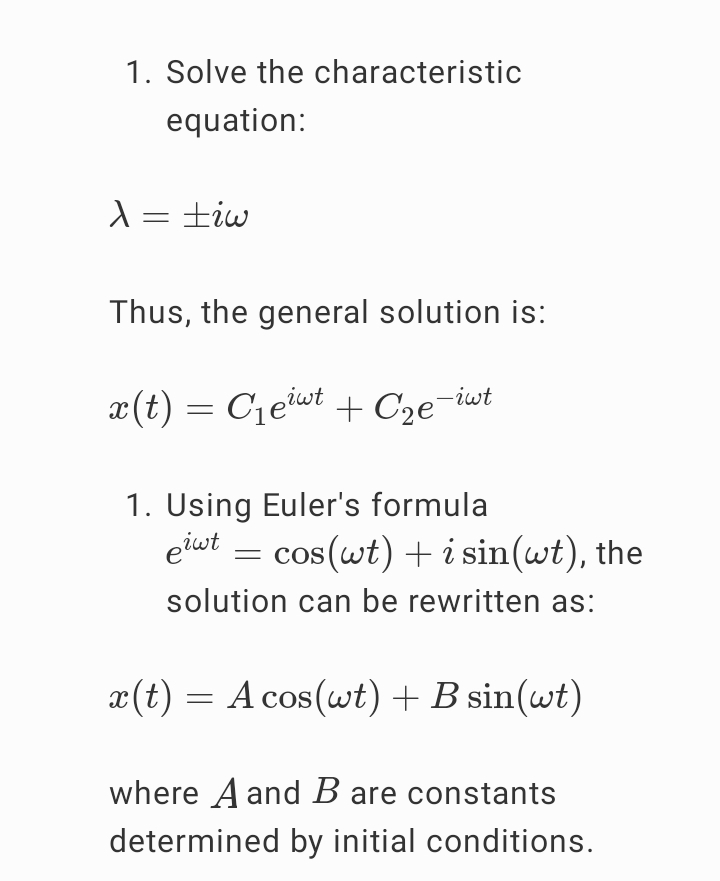
Let's solve this differential equation and observe the steps carefully:
so by solving this characteristic equation,we can determine the solution for x(t) in the proceedings as follow:
Therefore,we have finally solved for x which is the displacement of the harmonic oscillator from its mean position.
Note that the values of constants A and B can be determined from the given boundary conditions. Here we will find the values of these constants based on the boundary conditions as follow:
The last expression for x(t) is the final solution when you are giving boundary conditions.
So it's time to understand the concept of "boundary condition".
***What is boundary condition?***
A boundary condition specifies the values or behavior of a solution to a differential equation at the boundaries of the domain where the solution is defined.
By applying boundary conditions to the solution of given differential equation,we get the following information :
1.Uniqueness: When you solve any differential equation,you actually get a family of solutions which is called 'general solution' and this obtained by introducing unknown constants in the solution (in above example A and B are unknown constants which give us general solution).
By applying boundary conditions,they help in selecting a single solution from a family of possible solutions to a differential equation.
2.Physical Interpretation: In physical problems, boundary conditions often represent real-world constraints, such as fixed ends of a string, heat flux at a surface, or electric potential at a boundary.
Thus,boundary conditions serve as essential "guides" that anchor the mathematical abstraction of differential equations to the real-world system they represent.
___________________________________________
Some of the best books for beginners/advanced levels:
1. MD Raisinghania (for ordinary and partial differential equations )
2.HK Das(Mathematical Physics)
3.
Best Strategy To Solve Any Differential Equation:
Look at these following steps:
1. Understand the give differential equation.
2. Avoid fear and get prepared confidentially.
3. Boundary Conditions
4. Simplifications
5. Understand its classification
6. Adopt methods of solving the D.E.
7. Hit and trial methods should always be the first approach(for self study) and it always works well.
8. Check your solutions by substituting your solutions in the given D.E.
Continued.........




Comments
Post a Comment